What You See Inside Vatnshellir Lava Cave
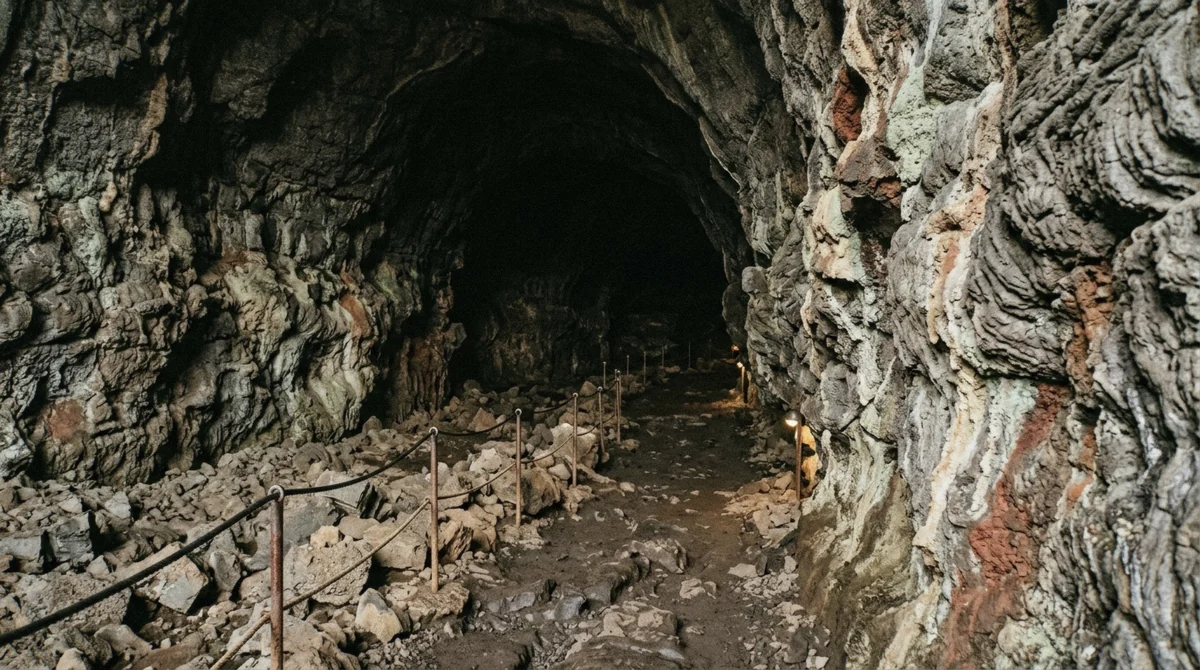
What you see inside Vatnshellir lava cave is three chambers on two levels, joined by two spiral staircases and lit by nothing but the torches your group carries. The route is about 200 metres long and bottoms out 35 metres under the lava field. What makes it worth the descent is not scale, because there is not much of it, but age and colour: this tube drained about 8,000 years ago, and the iron, sulphur and copper that seeped into the walls afterwards left them red, yellow and green. Start times and what a ticket covers are on the 45-minute guided tour.
Quick answer
You walk three chambers on two levels, 200 metres of passage in total, down to 35 metres below the surface. The walls carry rust-red iron, pale-yellow sulphur and green copper staining, along with lava statues frozen in place as the flow drained. At the bottom the guide has everyone switch off their torches.
Key takeaways
- Three chambers on two levels, joined by two spiral staircases
- 200 metres long, 35 metres deep at the lowest point
- The lava came from the Purkhólar crater row about 8,000 years ago
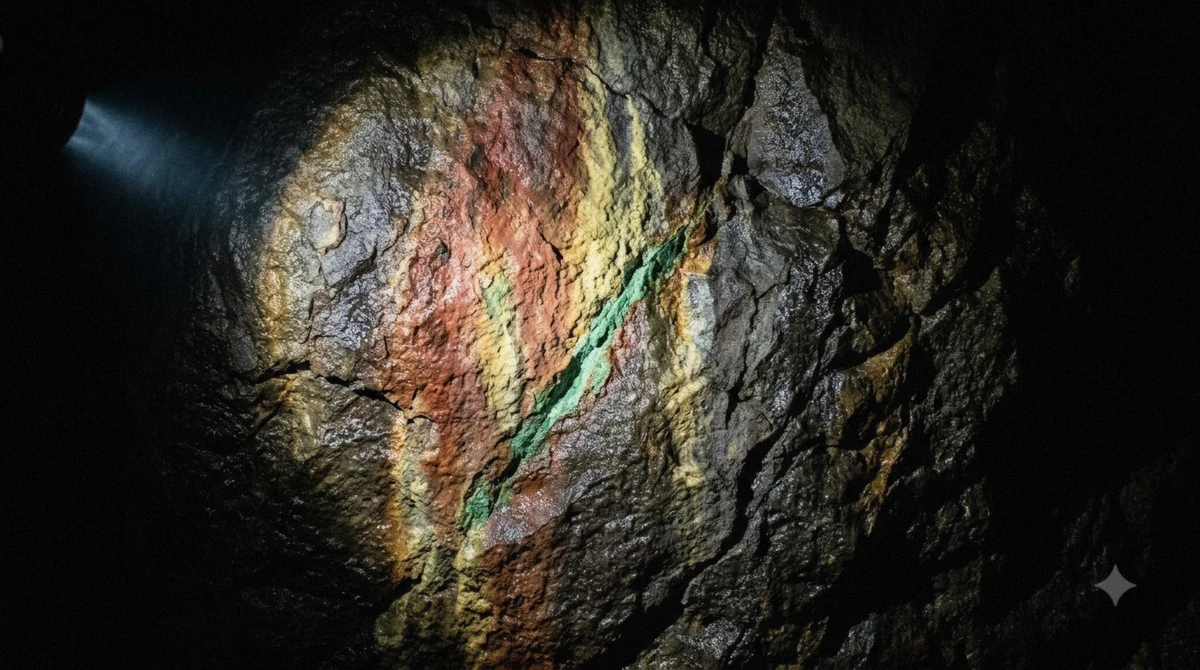
- Iron reads red, sulphur yellow, copper green
- Limited lighting and no built walkway: the torch stays in your hand
- One minute of total darkness at the deepest point
How the Cave Came to Exist
The Purkhólar eruption
The lava that built Vatnshellir came out of the Purkhólar crater row, a line of vents on the lower slopes below Snæfellsjökull. That eruption ran about 8,000 years ago, which puts this cave in a different bracket from the other lava tubes Iceland lets people walk into.
For scale: the eruption that built Raufarhólshellir near Reykjavík ran about 5,200 years ago, and Víðgelmir in west Iceland dates from around 900 AD. Vatnshellir predates both by thousands of years.
Why a lava tube is empty
A lava river running downhill loses heat fastest at its surface. That surface crusts over and becomes a roof, and the flow keeps running underneath it, insulated. When the eruption stops, the last of the melt drains away downhill and leaves the roofed channel standing empty.
That is the whole mechanism, and it explains most of what you see down there. The ledges along the walls mark levels where the lava paused as it drained. The smooth ropy texture is pahoehoe, formed as the skin of the flow wrinkled and set. The tube is not a crack in the rock; it is the shape of a river that left.
A water cave with no water
Vatnshellir translates from Icelandic as water cave, which puzzles everyone who gets to the bottom and finds a dry floor. The name refers to the water source at the farm above rather than anything inside the tube, and no river ever ran through here. Rain does work its way through the rock in a few places, so expect damp patches on the lower level, not a stream.
The novel the operator keeps quoting
Jules Verne opened Journey to the Center of the Earth in 1864 by sending his characters down through Snæfellsjökull, the glacier directly above this cave. The operator sells the tour as the first steps of that descent, and the line appears on almost every listing.
It is marketing rather than geology, and Verne never came to Iceland. What is true is that he picked the right mountain: the crater row that drained this tube sits on its lower slopes.
The Route, Chamber by Chamber
The whole descent, from the hatch in the lava field to the lowest chamber.
-
0m
The hatch
A metal structure over the shaft. Helmets and torches are handed out here, and the hatch is locked behind the group.
-
8m
First spiral staircase
Through the roof of the tube. The daylight behind you disappears within a turn and a half.
-
18m
Upper chamber
The lava statues sit here, along with the first ledges marking where the flow paused as it drained.
-
26m
Second spiral staircase
The drop to the lower level, on cold steel with your torch in one hand.
-
35m
Lower chambers
The strongest mineral colour, the deepest point of the route, and the minute with every light off.
About 200 metres of passage in total. You stop far more than you walk.
The Formations You Can Name
What is on the walls and what made it
The guide points most of these out. Knowing the words in advance means you spend the time looking rather than working out what you are looking at.
| What you see | What it is | Where on the route |
|---|---|---|
| Smooth ropy folds | Pahoehoe: the skin of the flow, wrinkled as it set | Throughout, strongest in the upper section |
| Lava statues | Shapes left standing as the flow drained past them | Upper chamber |
| Horizontal ledges on the walls | Levels where the draining lava paused | Both levels |
| Rust-red staining | Iron carried into the rock by water | Lower chambers |
| Pale yellow staining | Sulphur | Lower chambers |
| Green staining | Copper | Lower chambers |
| Short stubs on the ceiling | The broken bases of lava straws | Scattered, mostly gone |
| Rubble underfoot | Roof fragments that fell after the tube emptied | The floor, throughout |
The straws that are not there any more
Lava straws are thin hollow tubes that hang from the ceiling of a fresh tube, and they snap if you breathe on them. In caves that were open to unguided visitors for decades, they are almost entirely gone, and Vatnshellir is no exception on the parts of the route people could once reach.
This is the argument for the locked hatch. The cave is inside a national park, access is guided only, and what fragile detail survives does so because of that.
Why the Rock Is Red, Yellow and Green
Minerals, not paint
Basalt is grey. The colour in Vatnshellir arrived after the lava cooled, carried in by water working through the rock over thousands of years. Iron oxidises and reads as rust red. Sulphur shows up pale yellow. Copper leaves green.
One consequence of the cave's age is that it has had far longer than a young tube to accumulate this. Víðgelmir, at around 1,100 years, is bigger and emptier; Vatnshellir is small and stained.
The guide will put a torch beam on each in turn, which is the only way to see them: at a distance, in the dark, the walls read as uniformly black.
The Minute With the Lights Off
What actually happens
At the deepest point the guide asks the group to switch off every torch. Then nobody says anything for a while.
There is no light at all, which is not the same as a dark room. Your eyes do not adjust because there is nothing to adjust to. What people notice, and what comes up in review after review, is the silence: no wind, no water, no traffic, nothing. Some people report hearing their own pulse. Others get about twenty seconds in and want their torch back.
If that sounds unpleasant, say so before you go down. The guides do this at a point where turning a light back on is trivial, and nobody makes a thing of it. Who else should think twice about this tour covers the rest of that ground.
What You Will Not See
The honest list
The commonest complaint in recent reviews is not that the cave was bad. It is that people had not understood how small it is and how little of it you walk. Setting expectations properly is most of the fix.
- No flowing lava. There is none anywhere accessible in Iceland right now; the last eruption you could walk to was at Fagradalsfjall, quiet since August 2023
- No ice. This is not a glacier cave and not Lofthellir; the floor is dry rock
- No cathedral. The chambers are rooms, not halls, and the ceiling is close in places
- No show-cave treatment. No coloured floodlights, no illuminated walkway, and rope rails on only part of the floor
- No long walk. 200 metres of passage, covered in 45 minutes because you stop constantly
- No stalactites in the limestone sense. What hangs here is volcanic and mostly broken
What you get instead
A guide who knows the geology, a tube older than any other you can enter in this country, colour you would not expect in basalt, and total darkness. Whether that trade works for you is a real question, and if you want the comparison against Iceland's other options, we rank all of them.
Expectation against reality
The reviews that go badly all sit in the left-hand column.
| What people expect | What is actually there |
|---|---|
| Flowing or glowing lava | Rock that stopped moving 8,000 years ago |
| A warm volcanic cave | 4 to 6°C, damp, all year |
| Ice formations | Dry rubble floor; no ice at any time of year |
| A long underground hike | About 200 metres, covered in 45 minutes |
| Lit walkways and handrails | Bare rock, and one torch per person |
| A vast cathedral chamber | Three rooms, the ceiling close in places |
| Delicate straw formations | Mostly broken stubs; the fragile detail is gone |
| A river, given the name | None: the name comes from the farm above |
Photographing the Cave
Working with one torch
Lighting is limited and uneven, so your exposure depends largely on where the torches happen to point. A phone will produce something usable of a wall a metre away and nothing at all of a chamber. Grain is not avoidable.
What works: get close, brace against rock rather than trying to hold steady, and shoot when the guide has a beam on a feature. What does not work: flash, which flattens the texture that makes these walls interesting, and tripods, which there is neither room nor time for. Your own headlamp would help and is not permitted.
The shot people actually want
The spiral staircase from below, with a torch beam coming down it. That one needs someone above you and no rush, so ask the guide whether you can be last down. On a quiet winter departure with four people this is easy.
In July with a full group it is not.
Is This the Underground You Are Looking For?
If you want geology explained properly by someone who lives here
this is the right cave. Forty-five minutes, three chambers, a guide who will answer follow-up questions.
If you want distance underground
you want 1,360 metres at Raufarhólshellir rather than 200 here. The comparison is here.
If you want ice formations
this cave has none. Look at Lofthellir in the north or a glacier ice cave in winter.
If you are on Snæfellsnes anyway
book it. It is the only thing on this stretch of Route 574 you cannot see from the road.
If total darkness sounds like the worst part of your week
you can keep your torch on. Tell the guide before you go down.
Inside Vatnshellir Cave: Common Questions
How deep is Vatnshellir lava cave?
The route bottoms out 35 metres below the surface, roughly the height of a ten-storey building. You get there down two spiral staircases, one at the entrance and one between the levels.
How long is the Vatnshellir cave tour?
45 minutes underground. The tube is about 200 metres long, so the time goes on stopping and explaining rather than on walking.
Is the Vatnshellir lava cave tour worth it?
If you want the geology and you are already on the peninsula, yes. If you are picturing a long underground hike, no, and that mismatch is what the negative reviews are actually about. There are three chambers and 200 metres of passage, and knowing that in advance is most of the difference between a good visit and a disappointed one.
Which is the best lava cave in Iceland?
It depends what you want. Vatnshellir is the oldest at about 8,000 years, Raufarhólshellir is the longest walk and the closest to Reykjavík, Víðgelmir has the greatest volume. We compare all of them side by side.
Is there ice in the cave?
No. Vatnshellir is a dry lava tube. The floor is rock, and despite the name meaning water cave there is no water feature inside either.
Can you see lava?
Solidified lava, everywhere; molten lava, nowhere. Nothing in Iceland is erupting where visitors can walk at the moment. What you see here is the shape a lava river left behind 8,000 years ago.
Is it lit inside?
Only partly. There is some lighting at the staircases and enough to read the chambers by, but nothing like a show cave: no illuminated walkway and no coloured floodlights. The operator's own wording is limited lighting, which is why you are handed a torch at the hatch and why it stays in your hand the whole way.
What should I wear to see it properly?
Warm layers, gloves and shoes with tread. The cave holds 4 to 6°C all year and the floor is unlevelled rock. The full list is short.
The cave is small and the walk is short, and neither of those is a flaw once you know it in advance. What you are going down for is an 8,000-year-old shape in the rock, colour that took millennia to seep into basalt, and a minute of dark you cannot get anywhere above ground. Book a departure and let the guide do the rest.